Supply Chain Visibility
Transparency in the supply chain & selecting suitable visibility and control tower tools

Transparency in the supply chain & selecting suitable visibility and control tower tools





Volatile markets, global supply chains and increasing demands for responsiveness make transparency throughout the supply chain a crucial factor for success. Today, companies need not only data from individual systems, but an integrated overview of stock levels, transport, risks, deviations and relevant events, so that they can react at an early stage and make informed decisions.
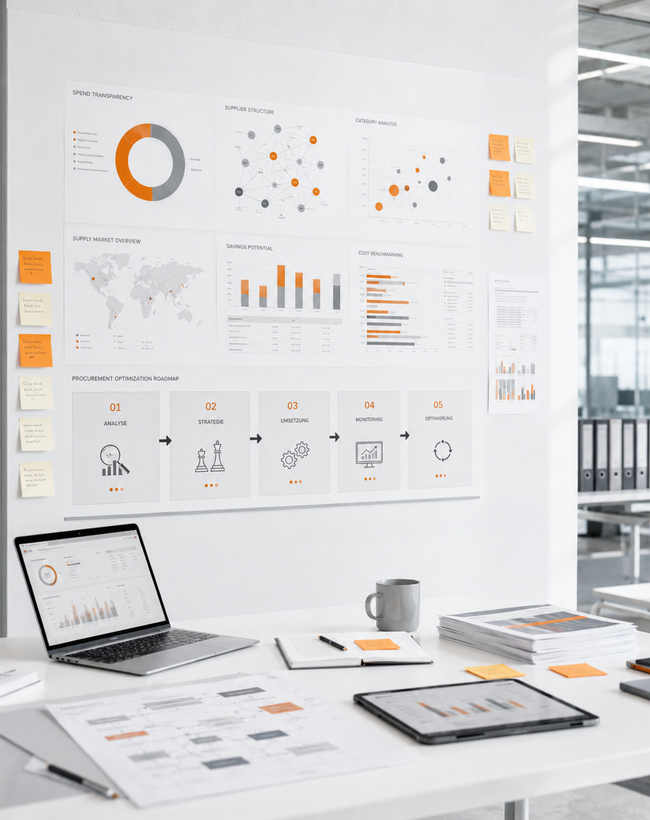
Supply Chain Visibility
Our project experience shows that effective supply chain visibility is achieved above all when stock levels, requirements and material flows are considered holistically. This enables stock levels to be analysed in a structured manner, risks to be identified at an earlier stage, and decisions to be underpinned by data.
Metroplan supports companies in systematically building supply chain visibility and translating this into an effective management model. In doing so, we examine data sources, processes, roles, dashboards, alerts and tool landscapes in their overall context and develop a target vision that not only visualises transparency but also makes it usable for operational and strategic decision-making.
In doing so, we view transparency not merely as a reporting issue, but as the foundation for better management: stock trends, demand, service levels and risk profiles are considered together.
An effective supply chain control tower goes beyond mere data collection. It consolidates relevant information from various sources, presents it in a consistent view and supports exception-based management with clear priorities, root cause analyses and options for action. Typical functions include real-time transparency, alerts, dashboards, drill-downs, KPI monitoring, collaboration and standardised response logic. It is crucial that not only are deviations made visible, but that the underlying planning assumptions, data logic and responsibilities are also traceable. Particularly in upstream processes such as Sales & Operations Planning, assumptions are frequently made that significantly influence stock levels, material flows and delivery capability.
Depending on the target scenario, supply chain visibility and control towers can cover both operational issues such as transport, stock levels and delivery dates, as well as risk-related or supplier-related transparency.
Tracking & tracing is a key component of supply chain visibility. Companies want to track shipments, orders, deliveries and material flows across relevant stages and identify discrepancies at an early stage. To this end, visibility tools often combine shipment data, stock information, external event data and status updates into a single view.
In practice, however, it is clear that the greatest impact lies not solely in technical visibility, but in linking tracking data, the quality of planning and clear response processes. Only in this way can urgent and special deliveries be reduced, material flows better synchronised and service levels stabilised.
Risk and supplier visibility are also increasingly becoming part of modern visibility concepts. Providers such as Prewave or Tacto combine external risk data, supplier information, ratings and market signals with internal data to identify deviations, risks and areas requiring action at an earlier stage.
For businesses, the key is not to purchase as many functions as possible, but to choose the right solution for their own supply chain. The market ranges from transport- and tracking-oriented visibility platforms to control tower solutions, risk monitoring tools and supplier transparency platforms. Examples of relevant solutions can be found among numerous large and small software providers.
Metroplan does not develop software itself and is therefore vendor-neutral in its consultancy and selection processes. We support companies in structuring their requirements, prioritising use cases, evaluating market options and selecting the appropriate tool suite for transparency, tracking & tracing, dashboarding and exception management.
To begin with, we identify which gaps in transparency need to be addressed and which decisions or processes require better support. These include, for example, transport transparency, visibility of stock levels, early risk detection, supplier monitoring and exception-based management.
In addition, we define the desired outcomes – such as reducing stock levels, improving on-time delivery, minimising ad hoc deliveries or achieving more robust risk management.
We then identify which systems, data sources, reports, event data and process responsibilities are currently in place. This reveals where data silos, missing data links or unclear responsibilities are limiting transparency.
In doing so, we examine not only the data quality itself, but also the quality of the underlying planning assumptions. Often, historical data is sufficiently accurate, whilst weaknesses lie in forecasts, S&OP assumptions or non-harmonised planning processes.
Im nächsten Schritt werden fachliche Anforderungen in konkrete Use Cases, KPIs, Dashboard-Bedarfe, Alert-Logiken und Tracking-&-Tracing-Anforderungen übersetzt. Daraus entsteht ein belastbares Anforderungsbild für Tool-Auswahl und Umsetzung.
Für die Bewertung von Potenzialen betrachten wir Bestandsentwicklungen im Zeitverlauf und immer in Relation zu Umsatz, Nachfrage, Servicelevel und Risikoprofil. So lassen sich konjunkturelle Effekte, Sondereinflüsse oder politische Krisen realistischer einordnen.
Based on the requirements, we provide support with market research, long-listing, short-listing and tool evaluation. In doing so, we consider functionality, integrability, scalability, governance and compatibility with the existing system landscape.
Finally, we support the roll-out of the chosen solution, its integration into processes and control routines, and the organisational embedding of dashboards, alerts and responsibilities. In this way, transparency is transformed into an effective management and control tool.
We work with our clients to ensure the effectiveness of these measures through defined KPIs, regular monitoring and clear action plans.
Supply chain visibility provides companies with a reliable, cross-functional overview of relevant events, risks, shipments, stock levels and discrepancies. Decisions become more informed, response times are reduced and disruptions are identified at an earlier stage. In projects with industrial, retail and logistics companies, our supply chain visibility initiatives have enabled us to achieve, amongst other things, sustainable stock reductions of more than 30 per cent across relevant product ranges and sites, a reduction in urgent and special deliveries of more than 50 per cent, and an increase in on-time delivery rates to over 98 per cent.
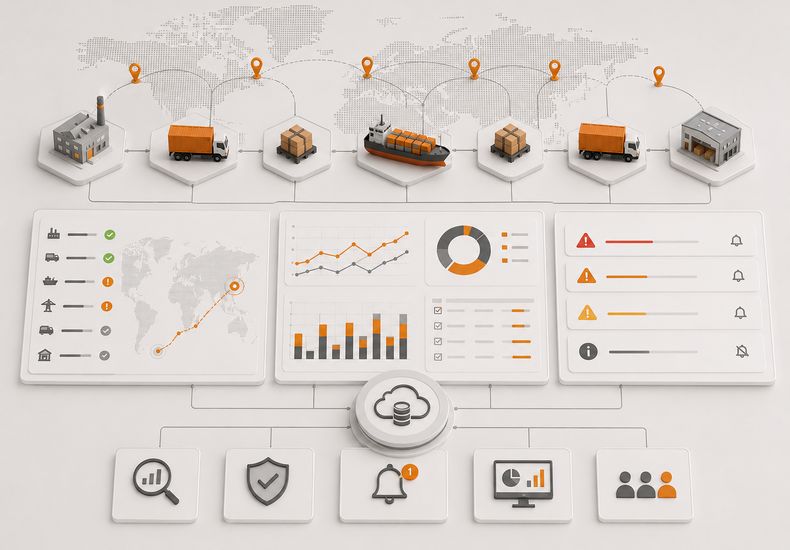
At the same time, an effective visibility strategy improves collaboration between departments and partners, as relevant information is made available in a structured, up-to-date and consistent manner. Combined with appropriate dashboards, alerts and tracking and tracing functions, this creates a robust management model for the supply chain. Supply chain visibility thus becomes not merely a transparency initiative, but an enabler for sound decision-making and sustainable improvements in performance.
Supply chain visibility is the right approach when companies want not only to establish transparency, but also to harness it for better control and faster decision-making. Metroplan supports you in defining your transparency requirements, evaluating suitable control tower and visibility approaches in a vendor-neutral manner, and translating these into an effective vision for your supply chain. In our experience, it is crucial to consider transparency, planning quality and operational control as an integrated whole – only then can data be transformed into concrete actions and measurable improvements.
Enquire about supply chain visibility
What does Metroplan mean by ‘supply chain visibility’?
Metroplan defines this as the structured creation of transparency regarding relevant events, stock levels, transport, risks, deviations and key performance indicators throughout the supply chain, combined with clear management and decision-making processes.
How does supply chain visibility differ from a control tower?
Supply chain visibility primarily refers to transparency regarding relevant data and events. A control tower goes a step further and combines this transparency with dashboards, alerts, prioritisation, exception management and defined response mechanisms.
What role do tracking and tracing and dashboards play?
Tracking & Tracing provides transparency regarding shipments, orders and material flows. Dashboards consolidate relevant key performance indicators, status information and discrepancies into a useful overview for operational control and management decisions.
Which tools are relevant for supply chain visibility?
Depending on the desired outcome, various types of tools may be suitable, such as control tower solutions, tracking and tracing platforms, risk monitoring tools or supplier transparency solutions. Examples of functions and solutions can be found, amongst others, from numerous software providers, both large and small.
Does Metroplan also provide support with selection and implementation?
Yes. Upon request, Metroplan provides support with defining requirements, selecting tools, designing the target architecture, and implementing and embedding the chosen solution within the organisation.
Contact

Managing Partner

Senior Manager

