Automation & Digitalization in manufacturing
Driving measurable value through digitalization and automation in production and logistics

Driving measurable value through digitalization and automation in production and logistics





Not every factory requires the highest degree of automation, but every factory needs the right one. The automation and digitalization solutions that create real value depend on factors such as production volume, product variety, process maturity, investment constraints, and the strategic role of the facility within the broader manufacturing network.
Success is not driven by the implementation of individual technologies alone, but by their seamless integration across production, logistics, and the supply chain. When applied effectively, digital systems and automated processes increase transparency, productivity, and quality while establishing a foundation for sustainable operational excellence.
A key challenge is identifying the most effective starting point and assessing opportunities from both a business and strategic perspective. An automation and digitalization strategy aligned with the company's overall objectives provides the basis for developing targeted concepts, prioritizing initiatives, and defining a clear roadmap for implementation.
By piloting selected measures, organizations can quickly demonstrate tangible results, build internal acceptance, and generate practical insights for subsequent implementation phases. This creates the foundation for a scalable transformation, expanding from individual processes to the entire factory and ultimately serving as a blueprint for the wider production network.
Our experience shows that digitalization and automation initiatives rarely fail because of technology limitations. More often, the challenge lies in the lack of integration across processes, technologies, and system landscapes. This complexity increases significantly in organizations that have evolved over time and operate within heterogeneous environments. Isolated IT systems, insufficient process standards, and temporary workarounds are just a few examples that can hinder successful implementation.
Particularly in small and medium-sized enterprises (SMEs), these conditions are often perceived as major barriers, delaying urgently needed transformation efforts in an increasingly competitive global market. In our view, however, limited digitalization or automation readiness should not be considered a showstopper. Instead, it serves as a valuable indicator of underlying weaknesses in processes, organizational structures, and system landscapes. Addressing these root causes creates the foundation for integrating technologies effectively and realizing the full value of digitalization and automation.
The success of your digitalization and automation journey ultimately depends on balancing three key dimensions:
Integrated digitalization and automation enable measurable improvements in manufacturing and logistics that cannot be achieved through isolated optimization initiatives alone. Companies that invest in the right areas can realize tangible benefits that directly support their business objectives. Success depends on aligning initiatives with actual operational challenges, as technologies that do not address underlying process weaknesses often create complexity rather than value.
Our experience across a wide range of industries consistently shows that five key areas can be effectively addressed through advanced digitalization and automation solutions.
Order progress is often unclear, while target and actual processing times are not consistently compared in daily operations.
Rush orders and disruptions frequently change production plans, while rescheduling relies on outdated data and manual effort.
Long search, transport and waiting times as well as uncoordinated material supply reduce production throughput.
Defects are often detected late in the process, while quality data remains distributed across isolated systems.
Unplanned downtime disrupts production because maintenance follows fixed intervals rather than actual equipment condition.
Our Quick Check is the ideal starting point for approaching the automation and digitalization of your factory. By complementing identified opportunities with a structured portfolio of improvement initiatives, we work together with you to develop a prioritized roadmap that enables a targeted and step-by-step increase in your factory’s level of automation and digitalization.
Within a short timeframe, the Quick Check provides a transparent assessment of current performance, identifies and quantifies existing opportunities, and translates them into an implementation-oriented improvement architecture. The result is a prioritized roadmap that provides clear direction for the next steps, complemented by quick wins that can be implemented immediately.
Quick Check
The Quick Check establishes the strategic foundation for all subsequent activities. During an on-site strategy workshop, we work together to refine the target vision and define which business objectives should be supported through automation and digitalization initiatives. Based on this shared understanding, we translate requirements and objectives into concrete action areas and develop a roadmap that provides the framework for further planning and implementation.
Planning
During the planning phase, identified opportunities are translated into concrete solution concepts. A detailed process analysis and maturity assessment provide a clear understanding of where the greatest improvement levers exist and what level of automation and digitalization is economically viable. A structured technology screening evaluates the current state of the art and identifies relevant solutions for your specific operating environment. Building on these insights, we develop a technical concept that defines the target architecture and outlines the required technical solutions in detail, including the corresponding system requirements


Realization
During the realization and ramp-up phase, we remain by your side to ensure that the developed solution is implemented in line with the planned concept and delivers the intended value in practice. Particular attention is given to ensuring that the defined requirements are fully reflected in day-to-day operations and that all relevant interfaces are effectively integrated and synchronized. To anchor the transformation sustainably within the organization, we proactively build the necessary capabilities and establish clear roles and responsibilities at an early stage. This ensures that new technologies, processes, and ways of working are successfully adopted, scaled, and embedded into the organization for long-term success.

The factory of the future is highly connected, adaptive, and capable of responding to change through autonomous decision-making within defined boundaries, all while maintaining ongoing operations.
Data forms the foundation of this vision. The seamless connectivity of machines and equipment, logistics systems, and IT platforms enables the creation of intelligent, self-managing factories. For many manufacturing companies, this represents the target state of tomorrow's production environment. Production systems communicate independently, processes adapt dynamically to changing requirements, and smart production ensures that operations are not only efficient but also proactively managed.
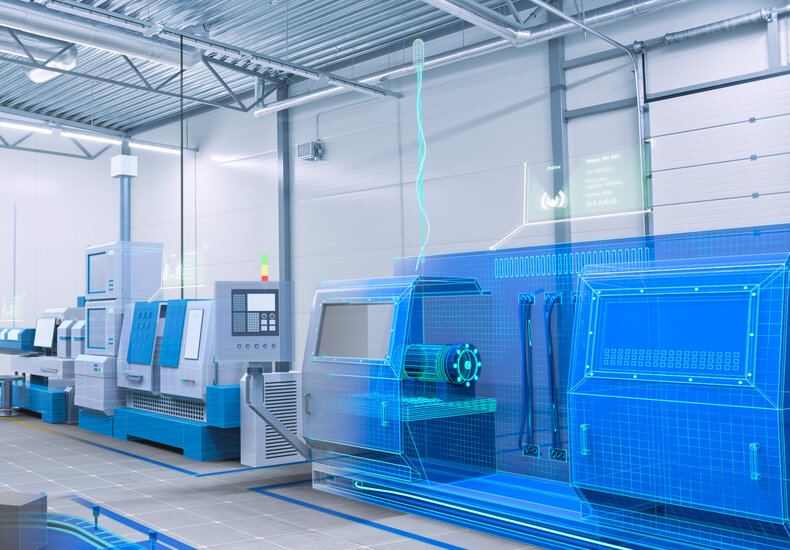
The foundation for this transformation lies in the availability, consistency, and reliability of data. At the center is the digital twin of the production system, enabling decisions to be simulated in advance, planning risks to be reduced, and changes to be validated before physical implementation. To actively leverage a digital twin, the necessary foundations must be established during the planning phase.
By developing a digital factory model, operationally relevant information is combined with the corresponding geometries and integrated into the factory layout. The parallel development of a simulation model complements this approach by adding a critical process perspective. Together, these elements create the foundation for true digital representations of production systems that can later be enhanced with real-time information.

The factory of the future
Future perspectives
AI agents autonomously detect deviations in production, adjust manufacturing orders and initiate follow-up processes. Production control can therefore respond in real time instead of reacting with delays.
Robotics with AI-based perception can respond to unstructured situations. This enables the automation of handling tasks that previously required manual work and creates new opportunities for automation.
AI processing directly at the machine instead of in the cloud enables millisecond responses, for example in inline quality inspection or process control, without relying on central systems.
Production systems can be prepared for humanoid robotics to address skilled labor shortages and improve efficiency. Suitable applications should therefore be identified at an early stage.
Campus networks connect equipment, sensors and mobile systems in real time while integrating enterprise IT with the machine level. This creates the technical foundation for digital factories.
As automation increases, human tasks shift toward monitoring, decision-making and troubleshooting. Training and workplace design determine how successfully new technologies are adopted in operations.
Many manufacturing companies recognize the need for automation and digitalization but are uncertain where to begin. This is exactly where our approach creates value. We help you establish a clear starting point, identify the most relevant opportunities together, and develop initiatives that are fully aligned with your business objectives. The result is a digitalization and automation strategy tailored to your production environment, processes, and operational requirements. By combining strategic thinking with practical implementation expertise, we ensure that technologies deliver measurable business value rather than adding unnecessary complexity
What is the difference between digitalization and automation in manufacturing?
Digitalization connects processes, machines, and systems, creating the data foundation required for informed decision-making. Automation replaces manual activities through technologies such as robotics and automated guided vehicles (AGVs). While both address different levers of improvement, their full potential is only realized when combined: digitalization without automation remains theoretical, while automation without a solid data foundation remains an isolated solution.
Is automation suitable for high-mix, high-variation production environments?
Yes, provided it is planned correctly from the outset. High product variety places different requirements on automated systems than stable, high-volume production environments. Modular architectures and standardized interfaces create the flexibility needed for equipment and systems to adapt to new product variants and batch sizes without requiring fundamental redesigns or reconfiguration.
Ab welcher company size do digitalization and automation become worthwhile?
Company size is not the deciding factor. What matters is the starting point: where are the biggest inefficiencies, which processes consume a disproportionate amount of capacity, and where the greatest economic levers can be found. For small and medium-sized enterprises in particular, a structured entry point such as the Metroplan Quick Check provides an effective way to identify opportunities and prioritize initiatives without requiring upfront investments in costly software or automation solutions.
Contact

Manager Business Development

Managing Partner


Prof. Dr. Alexander Koch // Senior Advisor Automation & Digitalization (HAW Hamburg)