Strategic Purchasing Optimization – modern & efficient
Zwei Geschäftsleute analysieren Einkaufsstrategien mit Laptops und Notizen – Symbol für Einkaufsoptimierung, Kostensenkung und Lieferantenmanagement

Procurement Optimisation Consultancy: Measurably optimising strategic procurement

Enquire about procurement optimisation

Schriftzug „Continental“ in schwarzer Serifenschrift, rechts begleitet von einem stilisierten steigenden Pferd; zentriert dargestellt auf einfarbig orangem Hintergrund, ohne weitere Elemente.
Logo mit Wortmarke „voss“; Schriftzug in kräftigem Magenta, fette serifenlose Kleinbuchstaben, gleichmäßige Strichstärke. Platziert auf weißem Hintergrund, zentriert, ohne weitere grafische Elemente oder Symbole.
Blaues Wortzeichen „GEA“ bildet ein stilisiertes Logo; eine horizontale Linie verbindet E und A und schneidet das E; weißer Hintergrund mit zentrierter, klarer Darstellung.
Wortmarke „OLYMPUS®“ in blauen Großbuchstaben, zentriert dargestellt; darunter eine durchgehende gelbe Linie mit kleinem weißen Punkt rechts, auf weißem Hintergrund.

How does the optimisation of strategic procurement work?


Procurement optimisation is the systematic, strategic and operational improvement of the procurement process with the aim of sustainably reducing costs, speeding up processes and increasing security of supply.An optimised procurement process is characterised by short lead times, high data quality, automated workflows and transparent KPI management, and forms the basis for effective procurement optimisation.Procurement optimisation identifies where procurement can realise economic and strategic potential; the process and digitalisation aspects show how workflows can be standardised and automated


5 characteristics of successful procurement optimisation

1

Order and Invoice Discipline

Every invoice is matched to a purchase order that was generated through an eProcurement platform and transmitted to the supplier. The rate of Maverick Buying, i.e. purchases made without involving Procurement, approaches zero.

2

Category and Supplier Management

All suppliers within a category are managed by a cross-site Commodity Manager. Negotiations are conducted on the basis of specific tenders and aligned procurement strategies.

3

Transparency of Procurement Spend

The entire procurement volume across all sites and categories is available in one system. Analyses of direct procurement, indirect procurement and project procurement can be performed using any filters. Procurement's contribution to value is aligned with Finance and continuously reported.

4

Measurable Supplier Performance

Supplier performance is continuously measured in terms of on-time delivery, quality KPIs, sustainability and innovation capabilities. The KPIs are improved through targeted supplier development until the agreed targets are achieved.

5

Early Involvement of Procurement

Procurement is involved at an early stage in upcoming projects, for example in new product developments, the implementation of IT systems, new advertising campaigns or the re-tendering of personnel services. This enables Procurement to take responsibility for and manage the tendering process from the outset.

Procurement optimisation: sustainably improving costs, resilience and value creation

Volatile markets, intense cost pressure and increasing demands for sustainability and compliance make procurement a key driver of profitability. Strategic procurement optimisation provides transparency regarding procurement volumes, product groups and suppliers, and prioritises measures according to savings potential, risk and strategic importance.

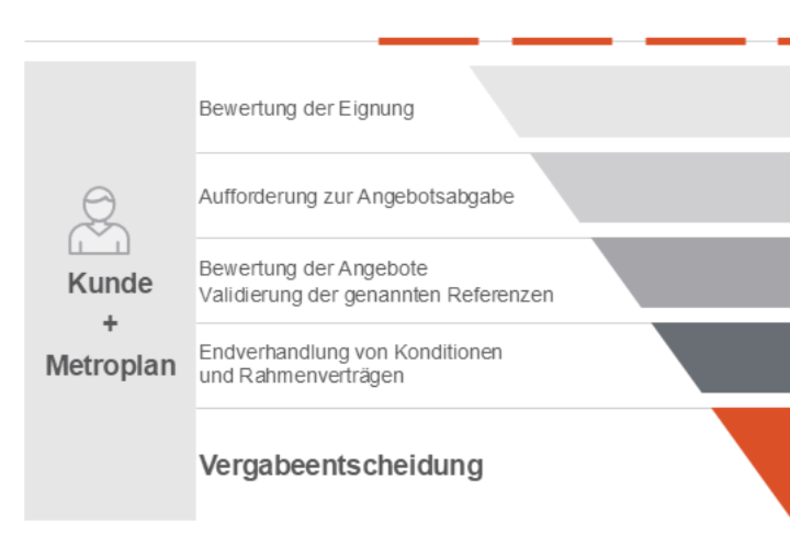
Grafik zur Optimierung von Einkaufsprozessen mit Bewertungskriterien für Lieferanten, Angebotsprüfung und Vergabeentscheidung.

The challenges facing procurement are manifold. They range from selecting the right suppliers and ensuring an efficient procurement process to minimising supply chain risks and complying with specific legislation – such as the Supply Chain Due Diligence Act (LkSG). Added to this are dynamic market conditions, cost pressures and increasing demands in terms of digitalisation, sustainability and compliance.

Companies should therefore systematically develop their strategic procurement: from spend and potential analysis, through product group strategies and supplier management, to measurable performance management using procurement KPIs.

Enquire about procurement optimisation

Best practices for strategic procurement optimisation

Metroplan offers comprehensive consultancy on purchasing optimisation and the optimisation of procurement processes, aimed at fundamentally transforming your purchasing processes. Using tried-and-tested methods, advanced technologies and our many years of purchasing experience gained from line management roles in international companies, we support you in making your purchasing processes fit for the future.

To this end, we analyse existing procurement practices in detail, identify areas for improvement and develop bespoke strategies to reduce costs, minimise risk and enhance procurement performance. Where required, we also manage the entire tendering process, support contract and price negotiations, and provide recommendations on the award of contracts.

Digitales Einkaufsportal auf einem Computerbildschirm mit verschiedenen Lieferanten, Suchfunktionen und Einkaufsoptionen.

Optimising procurement: Our 4-step consultancy process

  1. 1. Analyze Procurement Processes and Develop a Strategy

    We begin with a thorough analysis of your current procurement processes and structures. This includes evaluating your supplier base, analyzing procurement costs, and assessing risk management practices. The findings from this current-state analysis form the basis for a customized procurement strategy. The aim is to align procurement objectives with the company's overarching goals and includes measures to reduce costs, improve quality, and manage risks.

  2. 2. Implement Category and Supplier Strategies

    We prioritize categories based on procurement volume, risk, and business impact, develop suitable sourcing and negotiation strategies, and optimize the supplier base. We also embed quality, sustainability, and compliance criteria into tenders, contracts, and supplier evaluations.

  3. 3. Define the Right Processes and Digital Enablers

    Based on the procurement strategy, we derive the necessary process and system requirements. This includes the detailed digitalization and optimization of procurement processes as well as the selection and implementation of e-procurement systems and other IT systems – supplemented by suitable AI tools where appropriate. Further details are available on our specialized service pages.

  4. 4. Performance Management and Procurement KPIs

    Through regular assessments and analyses, we ensure that procurement performance is continuously improved and adapted to changing market conditions. To quantify savings in direct and indirect procurement, we use proven calculation methods and benchmarks. These are also available to procurement controlling, enabling transparent tracking and verification of the savings achieved.

Containerterminal mit Lastwagen, Containerschiff und Flugzeug – Symbol für internationale Logistik, Transportoptimierung und effizienten Einkauf von Logistikdienstleistungen

Kunden

Metroplan provided us with sound and effective advice throughout every stage of this challenging project. Metroplan’s staff have a thorough understanding of the processes in our industry – this has always helped us to resolve issues quickly.

Carl Beutlheuser

The benefits for you through optimised purchasing

  • Cost savings: Orders are processed more quickly and reliably, and can be automated. Purchases and deliveries can be consolidated, enabling better terms and discounts. Just-in-time ordering helps to avoid storage costs and excess stock.
  • Quality improvements: Ensuring the quality of products and services as part of a strategic supplier management programme with clearly defined specifications and quality requirements strengthens your company’s market position and promotes customer satisfaction.
Modernes Lager mit digitalem Dashboard zur Überwachung von Qualität, Effizienz und Bestandsmanagement.
Nachhaltiges Logistikzentrum mit Solaranlagen und digitalen Analysetools zur Risikominimierung in der Lieferkette.
  • Risk minimisation: Our strategic approaches to risk management help to minimise vulnerability to supply chain disruptions and other risks. These include, for example, early-warning systems, monitoring tools, diversification of the supplier base and risk-based inventory management.
  • Promoting sustainability: By integrating sustainability criteria into procurement, our customers comply with regulations and ensure the company makes a positive contribution in terms of climate, social issues and profitability.

Strategic Procurement Optimisation & Consultancy

Procurement optimisation is a critical factor for the success and competitiveness of businesses in today’s global economy. Metroplan offers a comprehensive solution that enables your business to transform procurement processes, realise cost savings, improve quality and manage risks effectively. By working with us, you gain a strategic partner committed to sustainable improvements and long-term success. Let us work together to optimise your procurement and thereby make a significant contribution to boosting your business performance..

Request a consultation on procurement optimisation


Best Practice: Procurement Optimization Objectives and KPIs

Clear objectives and measurable KPIs are essential for managing sustainable procurement optimization. Typical performance indicators make the value contribution of procurement transparent and enable improvements to be tracked systematically.

1
Order Rate [%] = Invoice Volume [€] ./. Order Volume [€]
2
Return from Payment Terms [%] = Cash Discount Benefit [€] + Benefit from Payment Terms [€] ./. Procurement Volume [€]
3
Procurement Volume per Buyer [€/FTE] = Procurement Volume per Category ./. Total Procurement Capacity [FTE]
4
Procurement Value Contribution [€/FTE] = Procurement Value Contribution across all Categories [€] ./. Personnel Capacity in Strategic Procurement [FTE]
5
OTIF – On Time In Full describes delivery performance and measures the proportion of orders that arrive at the customer both on time and in full.

FAQ on procurement optimisation in indirect procurement

Why is indirect procurement so different?


Unlike in direct procurement, indirect procurement often lacks bills of materials, automatic demand planning and, in most cases, consistent material numbers. Suppliers therefore receive hardly any valid demand forecasts; there are no orders with order numbers from the ERP system, and, furthermore, the tendering process is structured completely differently for each product group. Metroplan helps to systematically address these weaknesses and provides best-practice examples for every product group in indirect procurement.

What are the typical challenges?


Whilst materials such as office supplies, business equipment and IT hardware are ordered via catalogues, there are no standardised ordering processes for almost all services. Marketing, logistics and facility management services are usually contracted out without the procurement department being involved at an early stage. Metroplan has also implemented best-practice solutions in this area through numerous projects.

What practical methods are there for optimisation?


Metroplan recommends a parallel ‘top-down’ and ‘bottom-up’ approach.

The top-down approach involves defining guidelines, roles, IT standards and framework contract requirements. In the bottom-up approach, the procurement department gradually assumes responsibility for prioritised product groups. We implement this approach jointly for marketing, logistics and facility management services.

What measures form part of strategic procurement optimisation?

Typical measures include KPI-based spend and potential analyses, documentation of product group strategies, supplier consolidation, supplier development, tendering processes involving negotiations rather than maverick buying, risk management and, of course, transparent procurement monitoring at all times.

How can the success of procurement optimisation be measured?

Suitable key performance indicators include, amongst others, realised savings, process costs per order, order rate, maverick buying rate, on-time delivery rate, quality indicators and the full set of criteria for measuring value contribution in procurement. We would be happy to discuss which KPIs are truly suitable with you in a face-to-face meeting.

Contact

Your points of contact

Scroll to top