
Site assessment
Layout and functional planning
Cost estimation

Regulatory and approval-related assessment

Variant comparison
Schedule framework & project management





Before the first shovel hits the ground, we clarify the decisive question: Does your project pay off – or does it involve a risk? With our feasibility study, we provide a comprehensive analysis to determine whether a planned construction project is technically, economically, legally, operationally and schedule-wise feasible, and whether it can achieve the defined project objectives. Do you have different implementation variants in mind?
Are you unsure whether your planned building fits on the available site? Or do you simply want to know which option is the most efficient before entering HOAI planning? In these cases, an initial indication in the form of a feasibility analysis prior to overall planning can support your decision-making.
Enquire about feasibility study Discover further HOAI services
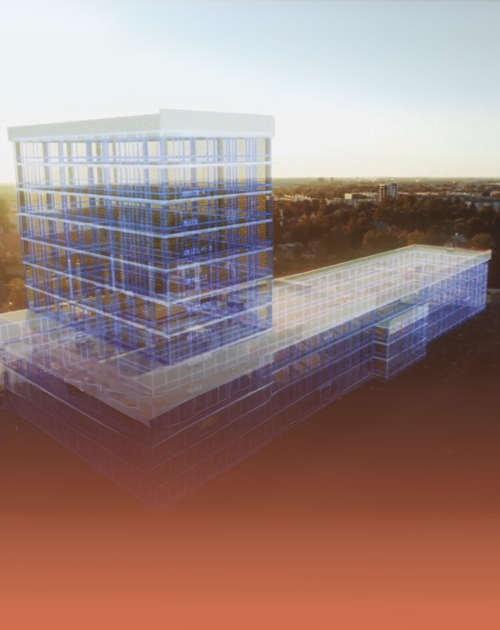
Site assessment
Layout and functional planning
Cost estimation
Regulatory and approval-related assessment
Variant comparison
Schedule framework & project management
The site assessment is one of the first steps in our feasibility study. Based on the development plan, we evaluate whether the customer’s building requirements can be realized and whether the strategic orientation of the entire site complies with the defined framework conditions.
This assessment can serve as an important initial indicator for both Greenfield and Brownfield projects.
Our layout and functional planning process is aligned with customer requirements regarding detailed site development. We develop space concepts that optimally coordinate workflows, technical zones and access areas, while remaining functional, efficient and expandable in a future-proof manner.
Our cost estimates are based on robust reference values from realized projects as well as current market prices. We structure costs in accordance with DIN 276, considering construction and technical costs as well as ancillary costs and risk buffers – providing a transparent and traceable basis for decision-making.
We review the planning and building law framework conditions of a project at an early stage. This includes analysis of development plans, §34 German Building Code situations, environmental and immission requirements, as well as coordination pathways with authorities.
The objective is to clearly assess risks and opportunities and strategically prepare the approval process. Upon request, we also proactively engage with the authorities.
Our variant comparison transparently contrasts different solution approaches and evaluates them in terms of economic efficiency, functionality and technical feasibility. This creates a robust basis for decisions, clearly highlighting opportunities, risks and investment differences with respect to costs and implementation timeframe, and enabling a well-founded site or concept selection.
Our scheduling is based on many years of experience and a clearly structured process. We develop schedules covering the entire project lifecycle – from the initial planning steps through the approval phase to implementation of your construction project.
Through structured presentation, we demonstrate at an early stage how long individual steps take, which milestones are critical and which dependencies must be considered.
A feasibility study is a form of project evaluation that considers all relevant aspects. Depending on the project objectives, the focus may be on economic, technical, or schedule-related factors. The primary goals are to assess whether the project is feasible at all and how risks can be minimized as effectively as possible. This comprehensive analysis enables proactive action.
This is particularly important in industrial construction, as subsequent changes can otherwise lead to significant downtime and loss of market share. A well-executed feasibility study is therefore not merely a formal requirement, but a genuine strategic competitive advantage. It strengthens the long-term resilience and adaptability of a company and represents an investment in future-proof operations.
We help our customers make the right decisions at an early stage!
There are two starting points and one objective: the right investment decision.
Not every construction project starts on a greenfield site, and not every existing building is an obstacle. Our feasibility studies therefore distinguish between two fundamental scenarios: Greenfield – new development, and Brownfield – redevelopment of existing sites.
In a Greenfield feasibility study, undeveloped land usually offers greater planning flexibility. Building boundaries are initially defined only by the development plan, allowing the building, access and expansion options to be planned as flexibly as possible.
In contrast, a Brownfield feasibility study requires early integration of existing structures, access routes and neighboring buildings into the planning process in order to leverage synergies and avoid restrictions. A key aspect is early evaluation of how much of the existing structure can be retained, adapted or reused.
Targeted integration of existing structures often enables significantly faster project realization and, in some cases, cost advantages.
It is therefore advisable to assess whether implementation on a Greenfield or Brownfield site represents the better long-term solution. We evaluate whether your construction project is realistic, economically viable and approvable, and which risks or potentials can be expected.
Planning approval required for your construction project? Click here for approval planning
A Greenfield project appears to offer maximum freedom: no contamination, no existing buildings, no constraints from prior use. Nevertheless, a detailed assessment is worthwhile – as undeveloped sites also entail challenges.
What we analyze:
Site potential & development options: Do your requirements fit the site?
Access & infrastructure: What technical infrastructure is required – power, water, transport?
Building law & approvals: What does the development plan permit, and what needs to be reviewed or adjusted?
Variant comparison & cost framework: Which layouts are realistic, and what does implementation cost?
Your benefit:
You receive a robust basis for cost-related decisions before land is acquired or planning services are commissioned.
![[Translate to English:] Visualisierung eines modernen Industriegebäudes auf freier Fläche mit Laderampen, Lagerstruktur und geplanten Erschließungswegen – Beispiel für ein Greenfield-Bauprojekt](/fileadmin/_processed_/8/c/csm_MachbarkeitsstudieGreenfield_9a5d4d8e3e.jpg)
![[Translate to English:] Visualisierung eines bestehenden Industriegebäudes mit angedeuteter Erweiterung und Lkw-Verkehr – Beispiel für ein Brownfield-Projekt mit Fokus auf Umbau, Sanierung oder Erweiterung](/fileadmin/_processed_/5/8/csm_MachbarkeitsstudieBrownfield_c58dbb9fc4.jpg)
Rethinking instead of starting from scratch. Brownfield projects involve sites with existing buildings – ranging from empty warehouses to active production facilities. The focus here is on intelligent further development: refurbish, convert, extend – or demolish and rebuild?
What we analyze:
Structural feasibility: Can the existing structure be technically and structurally extended or refurbished?
Utilization flexibility: Which operational requirements can be implemented within the existing structure?
Energy & sustainability: How can energy efficiency be improved – and is it worth it?
Cost estimation for variants: What are the costs of demolition, conversion or extension compared to new construction?
Your benefit:
You gain early clarity on whether investment in existing structures is worthwhile – or whether new construction is the more economical long-term option.

Managing Partner - General Planning

Business Development

